
Connecting Small Histories
seeks to record the footprint and heritage of the UK Jewish communities where they are now small or non-extant, and to connect these to existing Jewish history and heritage.
In this 12 month project, we have researched 6 locations around the country, as an indicator of the extent of this Jewish footprint in all parts of the British Isles.
Eastbourne •
Eastbourne welcomed many Jewish performers from 1875 who entertained the growing tourist population, in a range of venues. Many were refugees and some were from the Sephardi tradition.
Auguste Van Biene, the Dutch born ‘Magician of the Cello’ performed his ‘Broken Melody’ show at the New Theatre Royal (Hippodrome) in Seaside Road in 1896. Sephardi favourites at the Royal Hippodrome were the Boganny comedy troupe, who had appeared at the first Royal Variety performance in 1912. They were comedy slapstick and Risley acrobats, lying on their back and juggling with their feet.
Another Royal Hippodrome performer was Magician Carl Rosine, born Jakob Rosenzweig in Łodz, Poland, ‘The Napoleon of Mystery’. ‘Watch his thumbs’ said his 1905 theatre bills. He could catch hoops through his arms despite his thumbs being tied together.
‘Jewish Impersonators’ Hayman and Franklin, from USA, performed their popular ‘Cohen on the Telephone’ act at the Royal Hippodrome in 1906. Their record of this skit, about a new immigrant’s difficulty to make himself understood on the phone, was the first to sell a million.
The Pier Pavilion audience in 1907 were excited to hear ‘The Russian Gypsy Violinist’ Zacharewitsch, stage name Michael Sisserman from Ostrog in Russia, who had debuted as a 16 year old with Tchaikowsky.
In 1915 Devonshire Park Theatre boasted the illusionist The Great Rameses - ‘The Eastern Mystic’ - Albert Marchinsky, whose family had settled in the East End of London during the 1880s. His exotic ancient Egyptian act gave no clues to his roots. The acclaimed concert pianist Isador Epstein, born in The Hague, had also performed at Devonshire Park’s Floral Hall for a season in 1905, where he was the soloist for Beethoven’s Concerto in C Minor.
While the Grand Hotel on King Edward’s Parade boasted its famous Palm Court String orchestra led by Jewish musical directors, such as Simon Von Leer, Albert Sandler and Leslie Jeffries, music could also be heard at other venues.
Cecil Sapseid and his Savona Dance Band played for tea dances at Dale and Kerley’s fancy drapers store in the 1930s. It was on the corner of Terminus and Seaside Road. One of the musicians, Lou Morris, was the son of Alfred Morris, who founded the Eastbourne Hebrew congregation.
The Eastbourne Hebrew congregation was founded in 1918 and officially opened its Susans Road premises from 1922. Eastbourne Liberal Jewish community was founded in 2001.
St Annes •
In the early 1900's Syrian and Iraqi Sephardi cotton merchants created their family homes in St Annes, travelling to work in the metropolis ("cottonopolis") of Manchester. Joseph Smouha led the community with David Ades taking religious services and Ezekial Dunnous acting as Treasurer. An Ashkenazi influx in the 1920's established what is now the current community. A further influx of evacuees expanded the community even more during and after the Second World War. Today's synagogue was built in the late 1950's.
The St Annes map indicates the residences of many of the Jewish families from just before WW1 to the late 1950’s. Several of the residents had left the town by the end of that decade and returned to their home cities of Manchester, London, Leeds and Sheffield.
Adele House is the Headquarters of Beaverbrooks, the jewellers. The Adelstone and Brown families who owned the business lived in St Annes for many years.
[Researchers please note: Captions on the map entries are still being amended and updated. Please contact the Project Team to verify any details]
Sunderland •
Never a large community on the scale of nearby Newcastle upon Tyne. Nevertheless it had two synagogues, a Jewish school and a Yeshiva.
The now redundant synagogue on Rhyhope Road awaits a future, either developed for a new purpose or as a heritage museum.
The Sunderland diaspora is heartily loyal, despite being spread across the world.
Bradford •
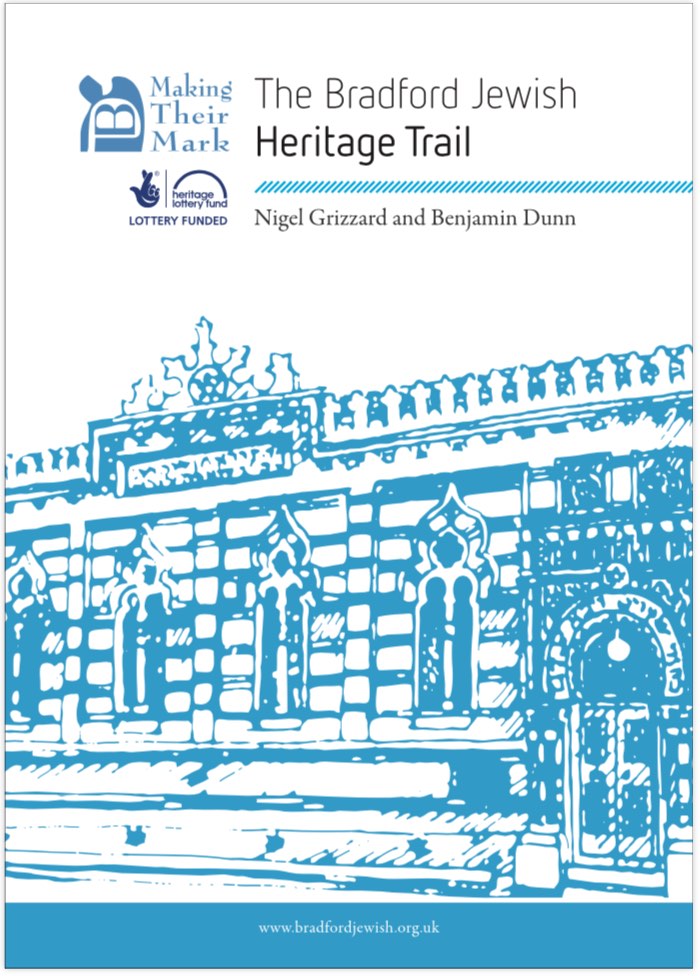
The Orthodox synagogue is now long gone. But the Reform synagogue, in the "Little Germany" district of the city, hangs on, though its members are few and services are similarly few. Its President, Rudi Leavor, is a skilful publicist, despite being in his 90's, so the synagogue's reputation is vast by comparison. So much so that it benefitted from a Royal visit in 2019.
Find Nigel Grizzard's Jewish Heritage Trail in our Bookshelf
Cumbria •
Barrow in Furness was probably the most established community, but there were also small communities in several Cumbrian towns. All have now vanished. But Cumbria draws many individual Jewish families, some to live permanently, others having second homes. Because of the remoteness, the religious links are usually with Reform communities in places like Manchester.
Somerset •
Jewish life is scattered across the whole of the Southwest, Dorset, Somerset and Cornwall. Plymouth has one of the oldest synagogues in the country.
There have been records of a Jewish presence in Somerset since the Norman Conquest. In 1290, this presence was chiefly lost because of the expulsion of Jews. Pre-expulsion, Bristol was one of the most important Jewish centres in medieval times.
On their return to Somerset under Oliver Cromwell, Jewish communities thrived. Bristol Hebrew Congregation’s community was in existence prior to 1743, and, after a number of moves, the synagogue can now be found in Park Row, Bristol. In addition, the Bristol & West Progressive Synagogue is also well-attended.
The Jewish community in Bath, Somerset came together around 1742, and the Bath synagogue dates from around 1815. Services ceased by 1874.
Taunton, the county town of Somerset, has a small Jewish community (the Somerset Jewish Social & Cultural Group) which meets regularly in people’s homes. There appears to be no record of Taunton having its own synagogue. Worshippers travel to either Bristol or Exeter, Devon.
During the 1930’s to the 1940’s, an Ashkenazi synagogue was created in the seaside town of Minehead, North Somerset. Services also took place around that time in a hotel in Bath.