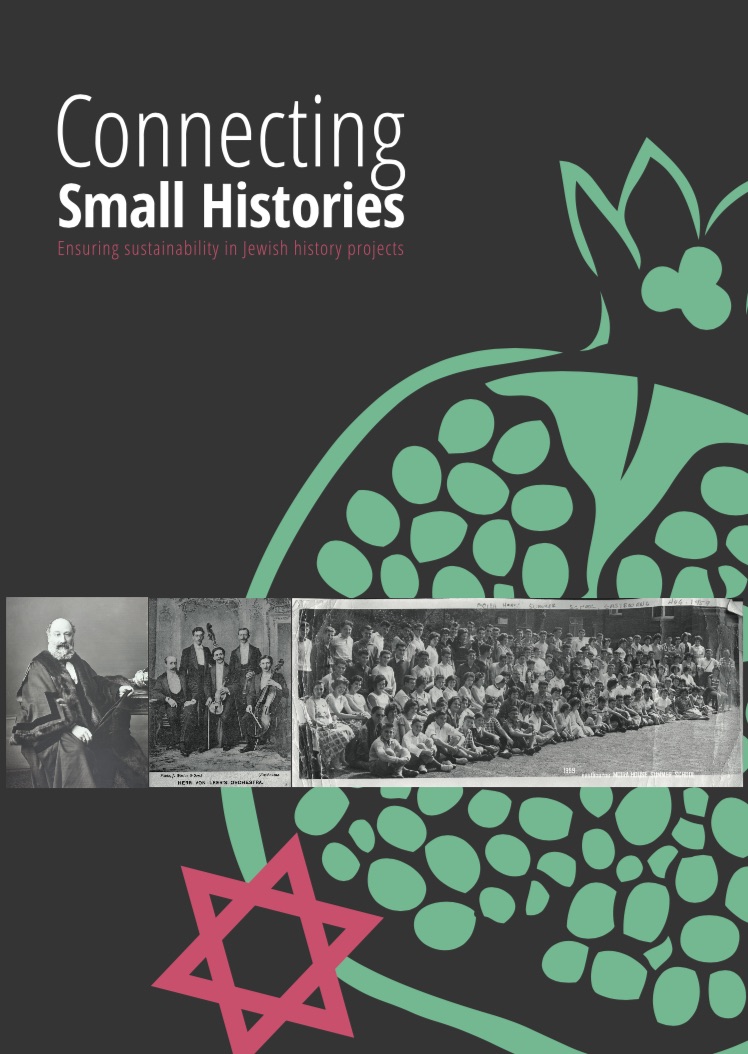

Additional resources for Key Stages 2 & 3
Supports any Judaism modules or activities,
including 'Heritage Detectives'
TOPICS:
- Resilience in small communities
- Jewish Festivals
- Jewish Objects
- Family Origins
- Diversity
HERITAGE DETECTIVES
- Heritage Detectives contains ideas and activities to support KS2&3 local history study.
- Topics in Heritage Detectives with other areas across the curriculum, in particular Religious Education.
- Designed for upper KS2 and KS3 learners, but activities can be adapted for the whole of Key Stage 2.
The activities in Heritage Detectives are accompanied by short videos, extended resources and teacher notes that will appear on this page.
Heritage Detectives was created as part of a collaborative project between the Jewish Small Communities Network and Swansea University (funded by the National Lottery Heritage Fund) bringing the public history expertise of the university and the community grassroots work of JCSN together to celebrate the heritage of small Jewish communities.
REVIEW
"This excellent booklet uses examples of Jewish heritage to encourage pupils to explore their own heritage. It inspires them not only to look around their local area but to think about the importance of community and learn more about their own family background. There are also links to various videos and extended resources to help both teachers and pupils.
A lot of work, including many revisions, have gone in to making this a must for all key stage 2 pupils."
- Sally Strauss
RESOURCES AVAILABLE HERE
Additional Word Bank Activities (1)
Videos (5)
Glossary and more information
Music (3)
Art PROJECT (1)
Additional Word Bank Activities

Throughout Heritage Detectives, you will see this sign. Here, students are invited to explore the definitions of important words and have a go at using them in a sentence.
We also recommend taking some time to look at other words, including:
Evacuated
Heritage
History

READ ONLINE
WATCH THE LAUNCH
Of special interest are the suggestions of how the book can be used across the curriculum, given by Sandra Teacher (starts at 41mins 40secs)

PAGE 7 ‘Small Communities’
The Jewish place of worship. Kosher is ‘Hebrew for ‘fit’ or ‘appropriate’ and most often describes the food that is suitable for a Jew to eat. Find out more [https://www.myjewishlearning.com/article/kosher-food/] ‘Challah is the Jewish Sabbath-and-holiday-bread. Challah is surrounded by folklore and tradition and loaded with symbolism.’ Find out more [https://pjlibrary.org/beyond-books/pjblog/august-2012/making-challah-for-shabbat]“Synagogue”
“Kosher”
“Challah”
PAGES 12-13 ‘Jewish Festivals’
‘Purim is a holiday marked by joyous activities. We dress up in fancy-dress costumes, share gifts of food with friends, give charity to those in need, have a festive meal with family and friends, and read a story… specifically, the story of Queen Esther – together.’ Find out more [https://pjlibrary.org/beyond-books/pjblog/march-2016/kid-friendly-purim-story] Queen Esther and Vashti are characters from the story of Queen Esther. “Esther and Vashti both stood up for themselves–and their beliefs in different ways. Vashti by refusing to compromise her values to appease the king and Esther by revealing her true identity to save the Jewish people.” ‘Hamantaschen are triangular pastries that are traditionally eaten on Purim. These treats are usually filled with jams, poppy seeds, or, in modern interpretations, chocolate hazelnut spread.’ Find out more [https://reformjudaism.org/jewish-holidays/purim/celebrating-purim-shalom-sesame-baking-hamantaschen] Hebrew classes The Jewish Festival of Lights. The word ‘Chanukah’ means ‘Dedication’ in Hebrew. It celebrates a miracle that happened in Jerusalem over 2,000 years ago.(Alternative spelling Hanukkah) Find out more [https://www.bbc.co.uk/bitesize/topics/znwhfg8/articles/zj446v4]“Purim”
“Vashti” and “Queen Esther”
Find out more [https://pjlibrary.org/beyond-books/pjblog/january-2021/books-about-vashti-and-esther]
[https://reformjudaism.org/jewish-holidays/purim/purim-story-families]“Hamantaschen”
“Cheder”
“Chanukah”
PAGE 15 ‘Jewish Objects’
‘A Tallit (or Tallis) is prayer shawl worn while reciting morning prayers (Shacharit) as well as in the synagogue on Sabbath and holidays. The tallit has special twined and knotted fringes known as tzitzit attached to its four corners.’ Find out more [https://www.akhlah.com/jewish-traditions/tallit/] Shul is Yiddish for synagogue, the Jewish place of worship. ‘Hebrew for ‘skull-cap’, a small hat or head covering that Orthodox Jewish men wear every day, and that other Jews wear when studying, praying or entering a sacred space. Also known as a yarmulke.’ Find out more [https://www.myjewishlearning.com/article/kippah/] Daily prayer book Hebrew for Sabbath, which comes from the Hebrew word for rest. It takes place weekly from sundown Friday to sundown Saturday. Find out more [ https://www.myjewishlearning.com/article/shabbat-101/] At the end of Shabbat, the Havdalah candle is lit. To watch a video about Havdalah and the Havdalah candle, click the link [https://www.myjewishlearning.com/article/havdalah-taking-leave-of-shabbat/] ‘Purim is a holiday marked by joyous activities. We dress up in fancy-dress costumes, share gifts of food with friends, give charity to those in need, have a festive meal with family and friends, and read a story… specifically, the story of Queen Esther – together.’ Find out more [https://pjlibrary.org/beyond-books/pjblog/march-2016/kid-friendly-purim-story] Passover (or Pesach in Hebrew) is one of the most important festivals in the Jewish year. It recalls the escape from slavery and exodus of the Children of Israel from Egypt. It begins on the 15th day of Nisan, the first month of the Jewish calendar. The festival lasts for seven or eight days, depending on where you live. Find out more [https://www.bbc.co.uk/bitesize/topics/znwhfg8/articles/zn22382] ‘On the evening before Passover [Pesach] starts, Jews have a special service called a Seder (Order) which recounts the journey out of Egypt. This takes place over a meal with family and friends at home.’ Find out more [https://www.bbc.co.uk/bitesize/topics/znwhfg8/articles/zn22382]“Tallit”
“Shul”
“Kippah”
“Siddur”
“Shabbat”
“Havdalah candle”
“Purim”
“Pesach”
“Seder”
PAGES 16-17 ‘Family Origins’
Shul is Yiddish for synagogue, the Jewish place of worship. ‘Each Friday evening, families around the world… take a break and spend time together and with community. An erev Shabbat (Friday evening) ritual that is both simple and beautiful is to light candles to “usher in” the Sabbath and set it apart from the weekday world. Immediately after lighting candles, special blessings are said over the wine or grapejuice, the challah, and in many families, over the children as well.’ Find out more [https://pjlibrary.org/shabbat] ‘On the evening that Passover [Pesach] starts, Jews have a special service called a Seder (Order). This takes place over a meal with family and friends at home.’ ‘Passover [Pesach] is a celebration of the story of Exodus. During Passover [Pesach], Jews remember how their ancestors left slavery behind them when they were led out of Egypt by Moses. Passover is celebrated with a series of rituals. Each ritual symbolises a different part of the story.’ Find out more [https://www.bbc.co.uk/bitesize/topics/znwhfg8/articles/zn22382] ‘One of the many fun customs associated with Passover is to search for, collect, and destroy any chametz (leavening or grain that ferments) in the house. Children are particularly enthusiastic about this “search and destroy” mission. Look any place in the house where chametz was used during the year… Use the feather to sweep all the crumbs into the spoon and deposit them in the paper bag. The next morning, make one final search and then burn or discard the bag and its contents.’ Find out more https://reformjudaism.org/beliefs-practices/prayers-blessings/blessing-searching-and-removing-leaven-chametz] ‘Traditionally recited at the seder by the youngest child present, the Four Questions, or Mah Nishtanah in Hebrew, ask about certain Passover rituals.’ Find out more [https://pjlibrary.org/four-questions] ‘The Jewish Festival of Lights. The word ‘Chanukah’ means ‘Dedication’ in Hebrew. It celebrates a miracle that happened in Jerusalem over 2,000 years ago.’ (alternative spelling Hanukkah) ‘Some dishes have special significance, such as latkes (a kind of potato fritter), pancakes and doughnuts. This is because they are fried in oil. When they make them, Jewish people remember the miracle of the oil lasting eight days in the temple.’ Find out more [https://www.bbc.co.uk/bitesize/topics/znwhfg8/articles/zj446v4] ‘Hamantaschen are triangular pastries that are traditionally eaten on Purim. These treats are usually filled with jams, poppy seeds, or, in modern interpretations, chocolate hazelnut spread.’ Find out more [https://reformjudaism.org/jewish-holidays/purim/celebrating-purim-shalom-sesame-baking-hamantaschen] ‘The Chanukiah (sometimes called a menorah) is the nine-branched candelabrum that is used on Chanukah.’ Find out more [https://www.myjewishlearning.com/article/chanukiah/]“Shul”
“Shabbat”
“Seder Night”
“Chametz”
“Mah Nishtanah”
“Chanukah” and “latkes”
“Hamantaschen”
“Chanukia”
PAGE 22 ‘Jewish Diversity’
Read more about Jewish diversity
https://www.myjewishlearning.com/article/sephardic-ashkenazic-mizrahi-jews-jewish-ethnic-diversity
Jews are diverse not only by background but also by colour

Art Project

Page 22: Diversity.
Students can colour in the letters in the booklet, create their own on plain paper or card, or download individual letters here to decorate as part of a larger group activity.