World Jewish Relief’s Approach Then and Now
– by Maurice Helfgott
As a lifelong supporter of World Jewish Relief, I have long admired how the organisation empowers people to reach their full potential. From assisting individuals to find employment, to improving resilience so communities can better respond to disasters, and helping older people become more comfortable and independent in their own homes: dignity is at the heart of its work.
Earlier this year I had the honour of being appointed Chair of World Jewish Relief. Our work resonates even more keenly as we negotiate a pandemic and one of the worst job recessions of our lifetime.
Over the past decade, World Jewish Relief has supported almost 13,000 people into employment, from Jews in Eastern Europe who face challenges such as displacement and disability, to individuals in East Africa who, through agriculture, are breaking out of the cycle of poverty. Since 2016, we have provided specialist support to resettled refugees in the UK on their journeys into employment, in partnership with local and national government.
This approach – helping someone to help themselves and become independent – is one I am a strong advocate of. My father, Ben Helfgott – now well known as Sir Ben – was brought to Britain in 1945 along with 731 other survivors of the Holocaust by World Jewish Relief, then called the Central British Fund for German Jewry (CBF). Having survived the atrocities of the Nazi concentration camps, and aged only 16, the CBF ensured that he and the other “Boys” went through an intensive process of rehabilitation, including learning English, playing sport, and building camaraderie.
Photo of Maurice and Ben
With the benefit of the early care and continued mentorship my father received, he and the other “Boys” were able to build successful careers and family lives. The CBF helped build the foundations, with which he achieved great things on his own merit. He knew the CBF would be there for him if he ever needed support, and in the end became its Honorary Treasurer and remains a loyal supporter of the organisation.
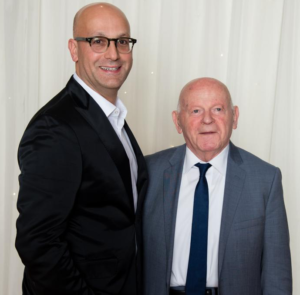
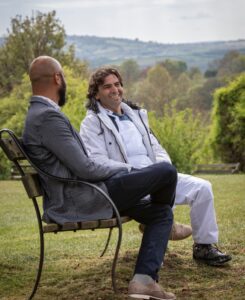
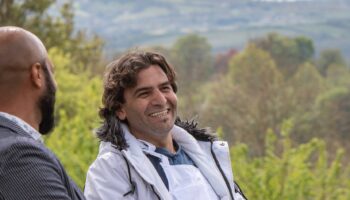
Photo of Saif and Ali
Saif (pictured) mentors refugees on our Specialist Training and Employment Programme who are setting up their own businesses. He said of this work “One of the greatest honours of this role is to hold up a mirror so people can see what skills and potential they have, and what difference they can make to their lives and to the community around them”.
This is not simply a World Jewish Relief approach – it is a deeply Jewish one, inspired by our texts and traditions. Jewish philosopher Maimonides taught that the highest level of charity is supporting someone through a business partnership, or a loan, to get them back onto their feet. This value underpinned the CBF’s approach in the 1940s, and it underpins World Jewish Relief’s work today.
As we support some of the most vulnerable members of the Jewish community and beyond through a period that has put unprecedented strain on employment and livelihoods, I am immensely proud of the work World Jewish Relief continues to do.