
Author: Jane Beckerman
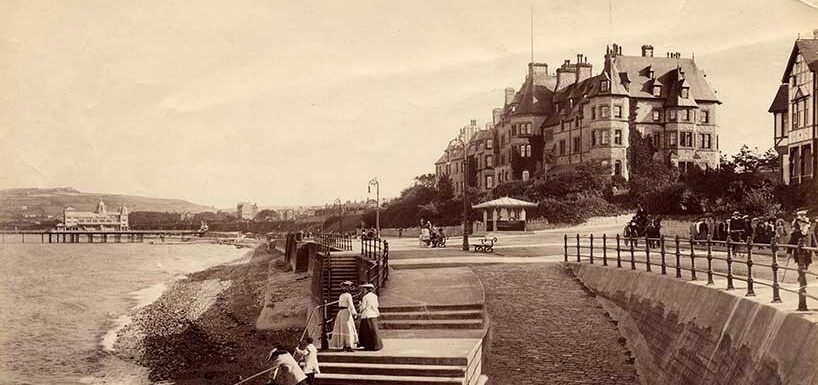
As you drive or walk through Colwyn Bay today you can see a memory of the Jewish life that was once part of this seaside town, situated between Llandudno and Rhyl, along the coast of North Wales.
‘Emmanuel Chambers’ is still to be seen on a window in Abergele Road, and almost underneath it, ‘Cohen Chemists’ is still providing pharmaceutical service to the town.
In ‘The Jews of Wales’ (pub.2017) Cai Parry-Jones writes about a revival of Jewish life during the Second World War: ‘As well as reviving defunct Jewish centres [notably in Rhyl], the arrival of evacuated Jews in Wales between 1939 and 1945 led to the establishment of new Jewish communities. In late 1939, many Jews from Liverpool, Manchester and London moved to the safety of Colwyn Bay on the North Wales coast and formed a congregation in 1940.’…‘a permanent synagogue was secured in a Victorian house in Princes Drive by Mark Bloom, originally from Manchester, in 1943.’
Much has been written about Jewish life and business in Llandudno, a much bigger resort town along the North Wales coastline, most recently by Nathan Abrams. The Wartskis and the Croops came to settle there at the very beginning of the 20th century, and other Jewish families followed. A Chabad still opens its doors every summer to visiting Chareidi families from Manchester. They also have an orthodox centre for mothers and newborn babies in the area.
I was keen to go back a bit further and look into Jewish life in Colwyn Bay before the war-time influx.
This short paper looks more closely at the Jewish history of Colwyn Bay and its next-door-neighbour, Rhos-on-Sea.
On 15th November, 1942, Robert Marshall and Ruth Cohen got married. The ceremony was held in Zion House on Princes Drive, in Colwyn Bay. Their marriage was solemnised by Rabbi David Wolfson, and they were not only the first couple to be married in the newly-established synagogue, but their marriage was also the opening event. The Marshall family and their friends and relations were part of this influx of city dwellers who were part of the history of Jewish residency along the North Wales coastline. Their story is evidence of the earlier occupation of Colwyn Bay by Jewish families.
Llandudno has a long history
Copper mining was established thousands of years ago on the Great Orme, the large mountainous outcrop of rock above the sea, overlooking the town that stretches along the coast. The wide sweep of land next to the Bay with the Great Orme behind it has been inhabited ever since. Slate and copper mining, fishing and boat travel to Ireland and the Isle of Man as well as Liverpool and even to Bangor on the old St. Tudno boat, were older occupations. More recently Llandudno has become a successful tourism destination for people living in the North West; Manchester, Liverpool, Stoke, and even Birmingham, as well as London and the regions.
Colwyn Bay and Rhos-on-Sea are also seaside towns, built by and for the convenience and relaxation of Manchester businessmen and their families in the late 19th C. They bought the miles of farm land just inland from the Bay of Colwyn and built on it from the 1860s; they copied the red brick buildings of their native city and created the attractive seaside villas that are still here today. The wealthy owners of these suburban and very English dwellings set off for Manchester in the mornings on the ‘Club Train’, had breakfast on board, and returned in the afternoon, having enjoyed a short day in the office and a restorative cocktail in the restaurant car on the way home. They were often met at the station in Colwyn Bay by their own chauffeured cars.
Ruth Cohen, married in Colwyn Bay on November 15th in 1942 at Zion House and was the daughter of Hannah and Mikel (Michael) Cohen. She was born in 1917, and lived on the newly built Fairway, North Manchester and she had a younger brother, David. David, born in 1927, had poor health and his doctor suggested that he would benefit from sea air. From the late 1920’s, the family rented a house in Colwyn Crescent in Rhos- on-Sea and spent months or weeks there several times a year. They walked down Penrhyn Avenue to the sea shore in Rhos, and visited the corner shop in Rhos Road on the sea front (immortalised by the artist Adrian Hill in one of his books). The shop, although small, sold sweets, tobacco, fancy goods, play things for the beach and fishing tackle, as its owner was a keen fisherman. The shop had been there for a long time and the owners were the Marshall family, a family with whom David was to become involved for life.
Joseph Marshall (Mashaal) was born in 1874 in Baghdad. In the year 1900 he married his cousin Farouah Lawee. They had their first child four years later. In 1912, Joseph Marshall came to Colwyn Bay to live and to set up shops in North Wales; sweet shops, tobacconist and fancy goods shops. Farouah did not join him until 1919, when she travelled via India with her four young children and her cousin, Mrs Sadka, on the first Troup Ship after WW1 to the U.K. The Sassoon family had arranged her travel.
She came over to live with her husband in a house at 52 Abergele Road in Colwyn Bay, at the top of Greenfield Road, next to what is now Antioch Chapel. She came with their four sons, Steve (Selim), Robert (Reuben), Norman (Naum), and Jack (Jacob). They had three more children after she arrived, Margaret, Violet and Benjamin. They chose the house because it was at the end of the tram line. Joseph hopped on the tram and went along the coastline to Rhos to the shop and then on to Llandudno, to visit his cousins, the Shamash and Gubay family, whom he had travelled with from Baghdad in 1912. Farouah bought the building at 61 Abergele Road, almost immediately on her arrival, across the road from their home and set up a gown shop on the frontage. Unusually for a Sephardi woman, she was a keen business woman; highly creative and resourceful.
Joseph had not come alone to Colwyn Bay in 1912. Joseph and his wife were cousins on both sides of the family and with him in the early 20th century came the Shamash family, cousins, who established the Oriental Stores in Mostyn Street in Llandudno. The Shamash family settled in Llandudno where Lulu Shamash had married a member of the Gubay family, also Joseph, in Baghdad. They had 10 children, four sons and six daughters. When their two daughters Eva and Norah married two brothers, Suliman and Abraham of the Fattal family, they moved to the newly-established Israel. In 1959, Albert Gubay, a grandson of Lulu and Joseph started the ‘KwikSave’ supermarket business in Prestatyn that lasted until 2009 and was a very familiar name along the North Wales coastline.
Another member of the Shamash family, born Isaac Ezra Shamash in 1923, changed his name by deed poll, and became a well-known and respected Labour politician in Manchester and later Lord Robert Sheldon. He died in 1915.
It is also to be noted that Joseph Marshall’s nephew, David Marshall, who lived in Singapore, became the First Minister of Singapore before Lee Quan Yeung became Prime Minister. He eventually became the Ambassador for Singapore residing in Paris.
Joseph Marshall’s children went to Colwyn Bay Grammar School until they were teenagers when Robert Marshall and his cousin, Eddie Gubay, the son of Lulu and Joseph, went to the Jewish boarding school in Paris. Robert came back in 1927, when he was officially 18 (although in Baghdad the men were always registered two years younger so that the authorities could not recruit the children at 11 years old and send them on ships to fight up the river). Robert began to help the family and took charge of the business his father had created, the small shops in Colwyn Bay and Rhos-on-Sea.
David Cohen began visiting Rhos-on-Sea with his mother, Hannah, for his health in 1928, as a baby, and in 1930 he was a 3 year old. Robert Marshall, as a young man had returned from Paris and begun overseeing the running of the sweets and ‘fancy goods’ shops. One was in Colwyn Bay, just opposite St Pauls Church, called George’s, and the other was in Rhos, on the corner by the sea.
Robert noticed young David as a quite frail but spirited little boy gazing wistfully at the fishing equipment for sale in the shop on the corner in Rhos-on-Sea and eventually Robert began to take him fishing whenever he visited Rhos and could spare the time. David became a strong and healthy boy and eventually a highly skilled and enthusiastic fisherman.
It was in 1940, ten years later, that Robert first met Ruth, David’s older sister, now living in Rhos with her parents since the beginning of WW2. Ruth had been asked to visit the Rhos shop to find out what time the service was for Shabbat. Robert couldn’t believe this lovely girl was David’s sister. They fell in love and married two years later, in the newly-opened synagogue in Princes Drive, the first ceremony to be held there, and they settled down to live in Rhos-on-Sea. This was the very first marriage of a Sephardi man marrying an Ashkenazi girl, unusual in those times, but many others followed in subsequent years. Ruth’s father, Mick, as he was known, came from a large family of ten, four brothers and six sisters, whose parents married in Whitechapel in London in 1898 In later years the sons set up the Morcosia raincoat company in Manchester. Mick was also a furrier.
Mick’s cousin, also called Maurice Cohen, was an adventurer who was born in London and later know as “Two Gun Cohen”. He was sent to Canada as a delinquent teenager and then invited by the Chinese Government as aide de camp to Sun Yat Sen and became a General in the Chinese army. There is a fascinating book about him. Maurice Cohen also set up the new main Manchester Synagogue and a benevolent society to help new Jewish immigrants to Manchester. An interesting and benevolent family.
Robert and Ruth had three children, one of whom, Gillian, has been the source for this part of the history. Gillian grew up in Rhos-on-Sea, and with her family and friends, went to Schul in Colwyn Bay. She grew up among the Jewish community along the coast, and remembers the families that were part of her life here as a child. Gillian’s mother, Ruth, was a member of W.I.Z.O., helping Jewish mothers and children in need in Israel, and she asked whether she might set up something for Jewish children where she lived. Thus was formed a youth group of Hanoar Hatzioni in 1959, holding weekly meetings, with members coming from along the North Wales coast and meeting in the synagogues of Colwyn Bay, Llandudno and Rhyl or meeting in people’s home in Prestatyn. People like the Hermans who owned an hotel, or the Ornsteins who had a pickling factory.
As well as the Shamashes and the Gubays, who were family, Gillian remembers her parents playing cards and socialising with the Benjamins, the Wartskis, the Mansons, Salisburys and with the Langleys, also jewellers and the Silvera family. There were the Kadhouries, Shashas, Lazars, the Glaziers, Cowans, the Barnets, the Harts and the Barker family who were furriers in Colwyn Bay’s West End, and latterly in Station Road in the centre of Colwyn Bay. During WW2 they also were great friends with the Sassoons and the Dellal family. Jack Dellal – who was later given the name ‘Black Jack’ because of his great luck – became a very well-known businessman, but Robert, Gillian’s father, remembered having given him his very first car!
Mr Kuchell was the first cantor in the Colwyn Bay synagogue, and was very highly regarded. Joe Barker and Harold Faulks were founder members of the synagogue, part of the first minyan together with Robert Marshall. Dr. Steve Salisbury, Lily and Lelio Silvera, Cecil Manson and Sarah Benjamin, the Langleys and the Comer family who owned the Embassy Rooms in both Llandudno and Colwyn Bay were close friends of Ruth and Robert Marshall, as were the Coopers, who owned a furniture shop in Llandudno. The Diamond family lived in Colwyn Bay and had businesses in Rhos, and a branch of the Sassoon family, again close friends of Ruth and Robert Marshall, had a house on the sea front, which after the war was purchased and run as a B&B by Gillian’s Uncle Norman and Auntie Victoria together with their daughter, Vivien, who had two brothers John and Alan Marshall. Gillian remembers that her brother, Laurence had his barmitzvah tea dance at the Embassy Rooms in Llandudno owned by the Comer family. Both Marshall and Cohen family and friends travelled to celebrate the occasion.
Some of these families had settled in, or were frequent visitors to Colwyn Bay in particular because it contained what was considered to be a ‘health hydro’. The Colwyn Bay Hotel on the sea front described itself as such and as David Cohen had come in the late 1920’s and 1930’s ‘for his health’, many other Jewish families came to sunbathe and to swim in the sea, off the piers in Rhos and Colwyn Bay. They also enjoyed the open- air seawater Swimming Pool in Rhos, where Robert Marshall won the high diving board Welsh Championships in the 1930s.
Being Jewish in Colwyn Bay
What was life like growing up in Colwyn Bay, or Rhos-on-Sea before and after WW2 if you were Jewish? During WW2 Harry Hyamson , originally from London, had opened the Arcadia Cinema in Colwyn Bay on Princes Drive and Gillian was told by her parents that he held ‘special’ film nights for the Jewish community, when Jewish families could gather to watch films, often very late at night, after the regular picture show had ended. The Jewish community had musical soirees and card evenings and a lovely time was had by all. She was told that there was never any shortage of food as the Food Ministry was in Colwyn Bay and nobody ever went short of anything!
Gillian was also told of the American Forces who joined in support in WW2. Jewish soldiers were offered the hospitality of the local Jewish families in Colwyn Bay and Rhos-on-Sea and Gillian’s parents had many to stay and kept in touch with many who later visited them years later remembering happy times spent in Colwyn Bay and Rhos-on-Sea. Many of the community remembered fondly memories of the war years in Colwyn Bay. For strictly kosher families, meat came in from Manchester or Liverpool, and was collected from Llandudno. Kosher meat could also be found in Llandudno Junction, where a shochet would come from Manchester to kill and kosher local meat.
Colwyn Bay before WW2 had a reputation as being rather ‘smarter’ than Llandudno. The shop fronts were of curved glass in wooden frames, the verandas along the streets were kept in good condition to keep rain and sun away from shoppers. ‘Barkers the Furriers’ were one of the shops that reflected Colwyn Bay at its most successful, as well as Glynn and Leinhardt, also furriers on Abergele Road at the top of Station Road.
The Barkers were one of the Marshalls’ close circle of Jewish friends for many years before and after WW2. Joe Barker, the furrier, kept the Friday night services going until the synagogue closed, together with Harold Faulks, who had a business in the covered market next to the Princess Theatre in Colwyn Bay. Robert Marshall helped out every Friday night to make up the minyan, but there were not enough people to hold a meeting on a Saturday morning, as most people were busy working.
After the end of war
After WW2, Robert Marshall and Simon Wegh, a skilled instrument maker and naturalised citizen, who had lost all his family in Czechoslovakia in the Holocaust, opened a mouth organ manufacturing business. However, the British government allowed the German mouth organ business back in and banned all use of copper so although they had orders from all over the world the business had to close. He then continued with his wholesale Fancy Goods business in Colwyn Bay, as well as the shop in Rhos-on-Sea.
Once WW2 was over many Jewish people who had settled in Colwyn Bay, Rhos and Old Colwyn moved back to Manchester, London, Westcliffe-on-Sea etc. but the small community still met on High Holidays and on Friday nights. Many from all along the North Wales coast and beyond would come to hear Mr Kuchell sing – he had the most amazing voice and was asked to go to New York to sing as a cantor, but he and his wife were so happy in Colwyn Bay living just off Greenfield Road and able to walk to Schul that he was content to live there happily with his wife until he died. He used to also give chedar lessons on Sunday morning to all the local congregation’s children and used to play the old organ in the synagogue. One of his three daughters, Bertha, was a wonderful school teacher who eventually left for Canada on getting married. Another daughter, Anita, taught ballet and stayed in Colwyn Bay after she married and became known as Anita Moss.
People known to Gillian’s family eventually moved away, mostly to Manchester but many still return on holiday and are saddened to see Colwyn Bay a shadow of its former self.
The synagogue in Colwyn Bay eventually combined with Llandudno, sometime in 1968, but the Chief Rabbi, Jacobovitz, visited during its active years, and items including the clock from the synagogue in Princes Drive are now in the Jewish Museum in Manchester.
Simon Wegh
Simon’s daughter, Rachel Wegh, adds…
Simon Wegh arrived in the UK on the 22nd May 1939 from Czechoslovakia. A Jewish refugee fleeing Nazi persecution. All others members of his direct family were murdered, other than his religious half-sister Suri who survived Auschwitz and relocated to London.
 He worked at a couple of knitting manufacturing companies in Godalming, Surrey and lived at a variety of addresses in the area between until 1943 when he moved to the Arts and Crafts estate of Limnerslease in Compton, Surrey. He lived and worked here for four years, in war and peacetime, for a company called Ardente who were manufacturers of scientific equipment for the Admiralty. A skilled instrument maker, he gained additional skills in home trade and export production. In addition to this, he joined the 5th Battalion of the Home Guard in 1940 until the end of 1944.
In June 1947 he moved to Rhuddlan Road in Rhyl. From here he moved to Colwyn Bay, first to Grange Road in August 1948 and then to York Road in November 1948.
The harmonica factory, which he set up with his business partner Robert Marshall, was registered on the 23rd September 1947. As my dad was still considered an ‘alien’ at this time, he was not able to commence production as the Board of Trade was withholding materials until he was naturalised. The company went on to be very successful but were forced to close in 1963.
It took him nine years of getting references as to his character and work ethic, checking in with police every time he moved or went for a job interview; even needing permission to own a bicycle to get to work, before he was eventually sworn in as a naturalised citizen on the 23rd February 1948.
Simon met Zena, a war widow, at a Christmas party of mutual friends in Colwyn Bay and they married in 1953. They went on to have four children and lived in Bay View Road, Colwyn Bay before emigrating to Israel in 1966. But the move didn’t work out and six months later they returned to the UK, staying temporarily in Stoke Newington, London before settling in Ilford, Essex in 1968 until Simons untimely death at the age of 64 in 1978.
Rachel Wegh (March 2023)
In the late 1960’s did anyone in Colwyn Bay encounter a gent called Jack Berwald, his wife ran a B&B and he retired from a job in London to assist?
I think he might have become a sub-postmaster at one time.
I took over the job he had in London after his leaving. He used to drive from London to Colwyn Bay on a Friday afternoon and back on Sunday, (good reason to retire).
Quite a character.
hello,
Was your mother a sister to Beattie and Joycey Corwin? They lived on Great Cheetham Street East, and were neighbours and Beattie was a close friend of my late mother, Ruth Libstein (later Ward, later Roland). right through their long lives.
My name is Neil Roland (www.neilroland.co.uk)
My mother Doreen Cohen later Corwin later Jacobs ,now passed on ,,knew Ruth Marshall very well from the Manchester days and kept in touch for many years whilst they lived in Rhos on Sea/Colwyn Bay.
How strange to see her story on your website