

Hilary Thomas received many responses to her appeal for information about the evacuee and wartime childhood experience in this seaside town, one that Jewish and non-Jewish children alike shared.
Here we present the stories….
…as told to her in phone and email conversations, as the Coronavirus lockdown prevented any face-to-face interviews. Hilary was able to make further connections through her historical research, and some of her findings are included in the book, Connecting Small Histories: Preserving Jewish Heritage, Sustaining Jewish Life.
Sisters Rita and Beryl nee Alexander (Liverpool)
Rita was twelve when the family arrived in St Annes from Liverpool in 1941 supposedly for a short holiday. In fact, they stayed for nearly two years. Her parents were Cecilia and Isaac, a pharmacist. His business was in Liverpool. He travelled there every day and Rita recalls how this caused her mother a great deal of anxiety. Rita attended Queen Mary School, her sixteen-year-old brother Cecil went to King Edward School and the youngest sibling Beryl attended the nearby Junior school. Rita recalls that there were other Jewish girls at her school. They had Jewish prayers instead of attending the main school assembly. The family rented a large flat over a shop at 52 Woodlands Road in the Ansdell area of the town. Their relatives from Sheffield, the Winston family lived in a flat in the basement. Another set of relatives, the Levison family, lived around the corner on Arundel Road. Rachel and Myer Cohen, their grandparents, also left Sheffield. They lived firstly at Arundel Rd, then moved to Woodlands Rd. Rita’s grandparents were Orthodox Jews so the household was strictly Kosher. Rita remembers her mother swopping bacon coupons for butter. Rita felt safe in St Annes and felt that most of the town was hardly affected by the War. She recalls the teenage Caplan sisters always looking very well-dressed as though they were going to a party !
(**HT note: I discovered David and Caroline Caplan in 1939 living at 8 Victoria Rd. David was an estate broker. They had two domestic staff including 32-year-old Malka Martha Gantz, possibly a refugee.)
Beryl recalls being the only Jewish child in her class. She had a lovely teacher called Miss Miles. The main memory Beryl has of the War was lots of flashing coming from the direction of Liverpool across the sea.
Although their grandparents were religious, Beryl’s parents and siblings never attended the synagogue or Hebrew classes. There were lots of children to play with including her cousins from Sheffield. Sadly Isaac Alexander died in 1942 aged 51. The family returned to Liverpool the following year so that Cecil could take up his university place.
Audrey nee Winston, cousin of Rita and Beryl (Sheffield)
Audrey, her twin Anthony and their parents Esther and Hyman first evacuated from Sheffield to Baslow in Derbyshire. They came to St Annes in 1941. Audrey recalls their big basement flat on Woodlands Road. It was not far from the Ansdell Institute, which she remembers as a handsome building where people met for concerts and other events.
(**HT note: In August 1944 the Jewish Chronicle reported that the Zionist Youth Group held a dance at the Ansdell Institute attended by several young Servicemen. It raised £40 for charity. That same year St Annes Womens’ Zionist Society, under the chairmanship of Mrs Raffles, organised a concert and party for children at the Institute and raised £90 for their charitable fund. The following year a dance was held which raised £100 for charitable causes including the Appeal Fund for Persecuted Children.)
Audrey recalls going with her family to the lake at nearby Fairhaven. Her father travelled daily to his business in Sheffield. Audrey’s family attended the synagogue occasionally. She and her brother had Jewish and non-Jewish friends at the local school and she has no recollection of any anti-Semitism. She was very close to her Alexander cousins who lived in the flat above and Shirley and Kenneth Levison, her other cousins who lived nearby. [Shirley Levison’s story is told in the project book.] Their mother Lily Levison, Esther Winston and Cecilia Alexander were sisters. Audrey recalls that St Annes was full of well-heeled families.
Greta A, nee Klingover (Manchester)
Jonathan Ferster contacted me to tell me that his mother, Nancy nee Halpern, and her two cousins Sheila Behrens and Greta Klingover, were evacuated from Manchester in 1939. Sadly Nancy and Sheila are no longer alive. Jonathan said Greta was happy to talk to me, but remembered very little.
Greta was seven when she and her older cousins, all pupils at Bowker Vale School in North Manchester were evacuated to St Annes. She recalls arriving by train together with lots of other children. She was happy because she, Sheila and Nancy were together the whole time, living with a non-Jewish family who were very kind. Greta cannot recall the name of the family or the address in St Annes. They were provided with simple food. Occasionally her mother Jane would come by train to see her. Her father Mark was in the Air Force. The girls all attended the nearby local school and mixed with local non-Jewish children. There was no Jewish education. Greta recalls attending a relative’s wedding in the town. Again she cannot recall any names. She does however remember occasionally visiting the Matz cousins from Manchester who were staying in St Annes. The three girls were away from home for about twelve months. Despite being away from her parents, Greta looks back on it as a happy time. She didn’t feel afraid or even realise that the country was at war.
Maureen B, nee Lewis (Salford)
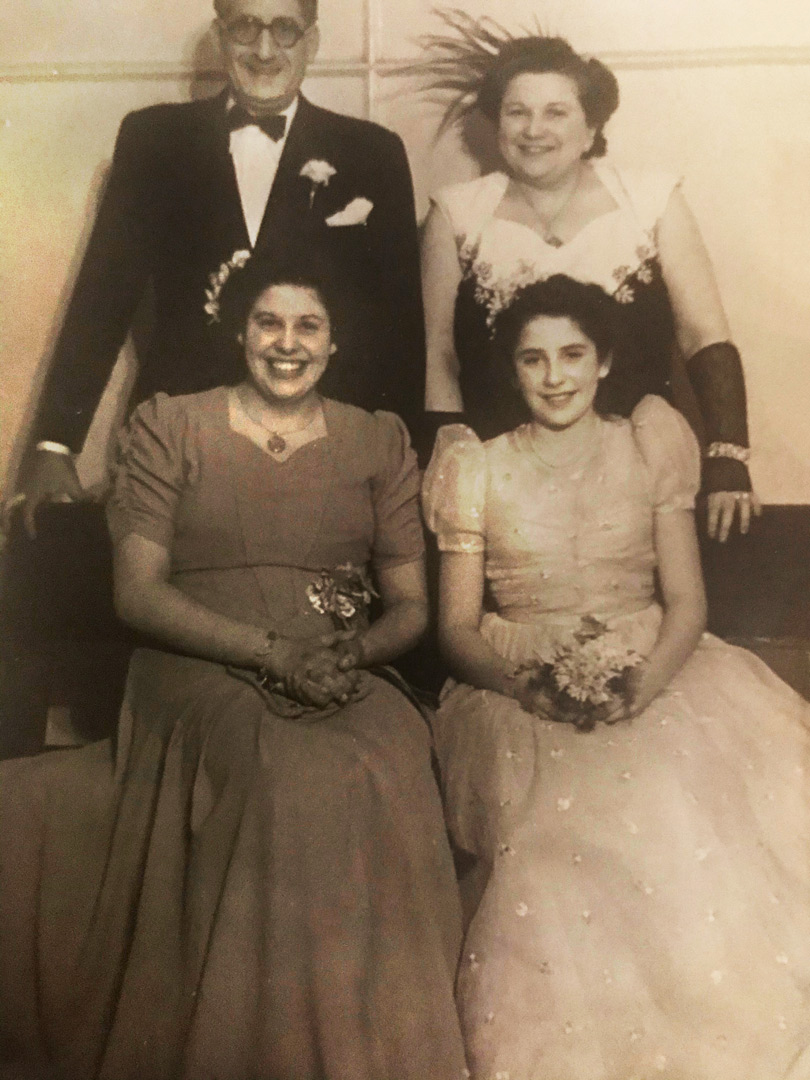
Maureen aged six, her elder sister Joy and their parents Philip and Bessie Lewis left their home in Broom Lane, Salford in 1940 for the safety of St Annes. Philip was a manufacturing optician and Bessie ran a factory making dresses and army uniforms. Philip travelled daily to his business in Manchester throughout the War. Maureen recalls that they both worked very hard but found time to get involved with synagogue life. [See our post on St Annes Shul History and Heritage.] Bessie was a member of the synagogue Ladies Guild, which helped organise finding homes for evacuees. Maureen recalls several families evacuating to St Annes from different cities including Jack and Reva Lynn from London,Mr and Mrs Arthur Smith from Sheffield, the Gilston family from Leeds, and the Satinoff, Libbert, Travers, Spector, Harris and Feather families all from Manchester. Maureen’s mother-in-law Sylvia was part of the Feather family.
Despite the War, there was a great deal of charitable and social activity within the Jewish community which continues to this day. Philip and Bessie were highly involved in the work of the Coordination of Charities committee which raised funds for both Jewish and non-Jewish causes. Maureen’s father was chairman of the committee for a number of years. She recalls that fundraising dinner dances were organised by the Committee in the 1950s which were held at Blackpool casino or The Palace Hotel and attended by guests from Manchester and Preston. She also recalls that just after the War, the League of Jewish Women organised day trips to St Annes for the residents of the Manchester Home for the Aged. There was a great deal of social interaction between the St Annes and other Northern Jewish communities.
Denis B (Manchester)
The Btesh family left their home in South Manchester on 1st September 1939, when Denis was aged 13. Elias, known as Johnny, his wife Dorothy, known as Dolly, and their four children spent the first two weeks at the Aishel Court hotel. Johnny bought a house on Eddington Road at a local auction for £1800. He was a textile exporter who travelled daily from St Annes by train to his business, Btesh Brothers, situated in the centre of Manchester. He was a regular attendee at the synagogue on Orchard Road. Denis occasionally accompanied him.
Denis recalls being able to see the bombing across the sea in Liverpool but never felt frightened. He also remembers the presence of the US Servicemen in the town.
He was a sociable young man and enjoyed acting. He joined the Unitarian Church actors group and the Ashton Gardens Dramatic Society. He enjoyed mixing with all religions and all classes. His friends in St Annes included the Sandleson brothers and the Shaffer brothers.
Denis attended King Edward Grammar School where there were several Jewish pupils. He left at 18 and went to the Royal Navy Training centre at Malvern Wells. Denis had three sisters: Reyna known as Girlie was born in 1914, Pamela in 1919 and Norma in 1931. (**HT note: I have discovered that Girlie served as assistant treasurer to the synagogue’s Jewish Womens’ War Service Committee in 1943.)
The family stayed in St Annes. Elias/Johnny died there in 1982 aged 94, Dolly lived until she was 104, Girlie died there in 2001. All are buried in the Jewish section of Lytham cemetery.
Denis’s children were born in the town in 1954 and 1957. The family lived on Islay Road.
Ruth nee Btesh (Manchester)
Ruth is the third of the five children of Isaac and Rena Btesh, who left Manchester and evacuated to St Annes in late 1940 when she was 5 years old. She recalls that they stayed for a few weeks in a hotel near Squires Gate then rented a house on Shelbourne Road. A year or so later they bought a house called ‘Dolomite’ at 189 South Promenade. Ruth attended Ardrossan Prep School. Her father travelled to Manchester each day by train with other Manchester businessmen. Ruth recalls that the family socialised with both Jews and non-Jews and there was no anti-Semitism as far as they were concerned. She recalls food rationing but the family managed to keep a Kosher household. Her father attended the synagogue. The Jewish families she recalls were the Adlestones, the Smiths, the Browns and the Goldstones. Her impression was that St Annes was a very safe place to be during the War. After the War, she went to a boarding school in Harrogate. Her parents stayed in St Annes until their return to Manchester in about 1960.
Anne C nee Goldstone (London)
In September 1939 Mark and Hilda Goldstone and four-year-old Anne left London and came to Manchester, hoping it would be a place of safety from the bombing. It was Hilda’s hometown and her parents Millicent and Mauricer Olsberglived there. However, by late 1940 the Goldstones had left that city and settled in St Annes. Their first home was in Bromley Rd. The Olsbergs also settled in St Annes towards the end of the War.
Anne recalls her mother telling her that during the War she acted as a billeting officer on behalf of the synagogue. Together with her friend Bessie Lewis she organised homes for children evacuated from London and other major cities. Mark and Hilda became stalwarts of the synagogue. Her mother was the chairman of the Chevra Kadisha and the Womens’ Zionist Society. Anne recalls that the Society held childrens’ parties and concerts during the War at the Ansdell Institute. Hilda was a founder member of the Jewish Womens’ War Services Committee together with Mrs Barnard, Mrs Kravitz and Mrs Travers. It liaised with local committees organising house-to-house collections and flag days in the town. During and after the War years Anne was a member of the local Habonim Youth club. She also attended Hebrew classes and was taught by Reverend Feldinger. Hilda and Mark spent the rest of their lives in St Annes. Anne was married at the synagogue in 1959. She and Sidney moved to Manchester where their two sons were born.
In 1975 Jack Rosenthal’s play The Evacuees was made for television. Most of it was filmed in St Annes. One of Anne’s sons had a small part as an evacuee in the production!
Estelle H nee Myers (London)
Estelle, born 1938, and her sister Doreen, aged 11, came by train from the Docklands area of London to St Annes in 1944. She recalls lots of children on the train from various schools around London. Her mother Jessie waved her goodbye. Her father Nathan was in the Forces. Doreen and Estelle stayed with the Auty family at 19 Cecil Street until the War was over. She recalls a totally female household apart from Ian Parkinson, the ten-year-old grandson of Mrs Auty.
(**HT Note: Estelle couldn’t recall any of the names of the adults. I have found them in the records: Ian’s grandmother Betty Auty nee Rukin (d.1945) was the widow of Luther, a stonemason. Her daughter Hilda married Henry Parkinson and had three sisters, Betty R., Mabel and Emma. The whole family were born in the Fylde area.)
Estelle recalls that they were decent kind people. The house was on a pleasant street full of handsome 19th-century dwellings. She and Doreen were well-fed. She recalled they were expected not to waste food. The local school was nearby and she and her sister attended regularly. She didn’t recall ever meeting any other Jewish children or having any Jewish input during her stay. In fact, on a Sunday she and Doreen sometimes accompanied the family to the local church. She and her sister spent a lot of time playing with Ian. Nearby was a lake where they often went. She recalls that the Auty women helped out at the nearby American airbase. Her mother visited from London only two or three times but was always welcomed by the family. In fact, the two families kept in touch for many years and the Myers family visited them in St Annes on a few occasions.
Estelle recalls that she was once taken to Blackpool to visit her Uncle Simie who was stationed there at an RAF camp. She also recalls the Lytham Summer Fete in 1945 when she was chosen to present a bouquet to the guest of Honour, Mabel Pickles. Estelle has nothing but happy memories of being an evacuee. She felt secure in St Annes.
(**HT note: 19 Cecil Street had been the home of the Rukin and Auty families since the late 19th century, and would remain in the family until 1994.)
Madeleine J nee Brown (Leeds)
Madeleine’s parents Percy and Constance Brown married in Leeds in 1938. Madeleine was born there two years later. Percy’s father Isaac was a jeweller and the 1939 Register lists Percy as a watchmaker. The family moved to St Annes in about 1947 a year or so after the birth of Madeleine’s brother Andrew. The Brown family were closely related to the Adlestones, whose business Beaverbrooks the Jewellers moved their headquarters to St Annes from Manchester in 1946. Percy and his brother Sydney became partners in the business.
Brian L (Manchester)
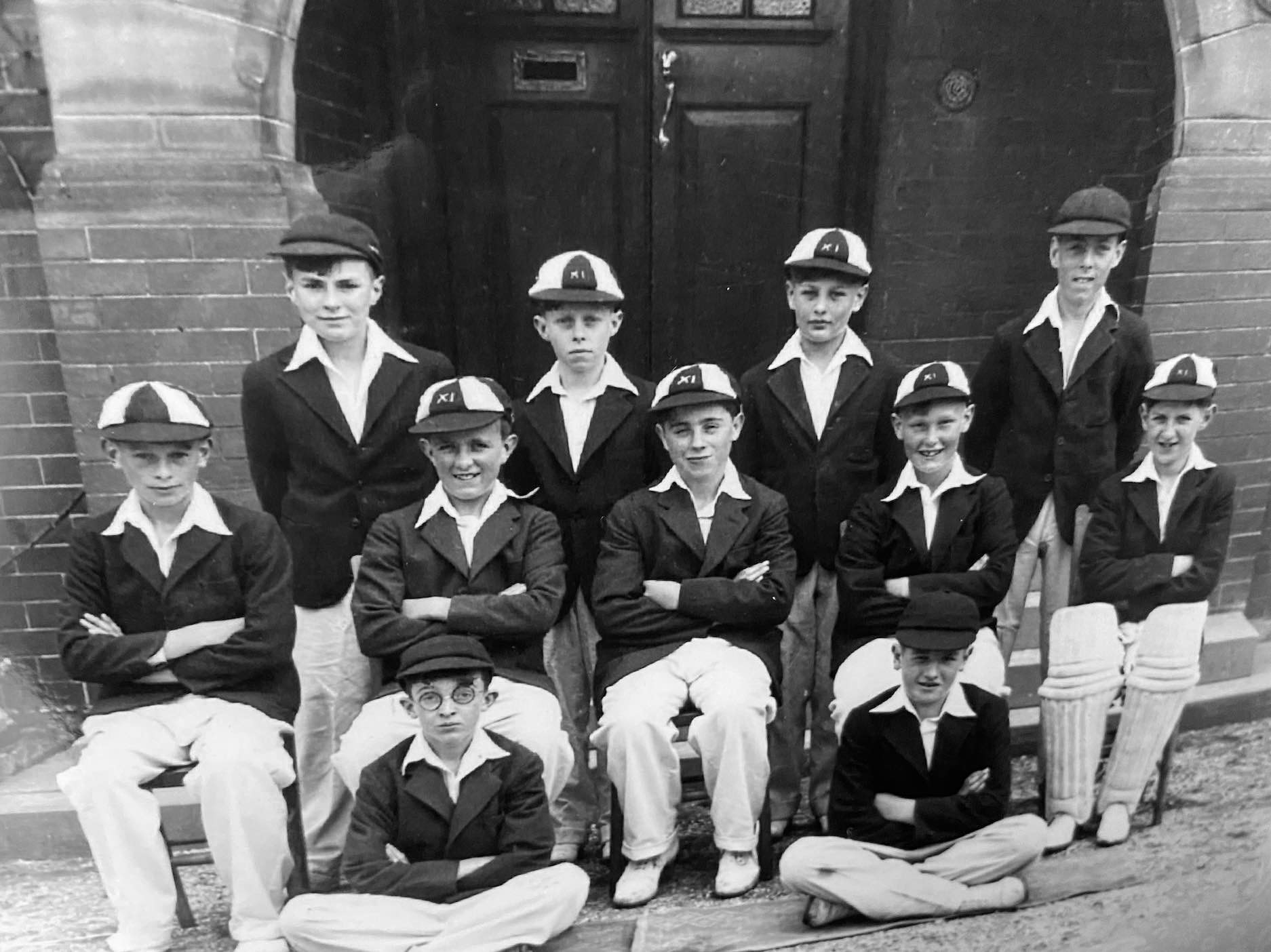
Brian was only a year old when he, his parents and brother Jonathan arrived in St Annes from Manchester in 1940. His fondest memory is of being given a baseball as a gift by one of the American Jewish Servicemen who came to dinner at the family home on Clifton Drive. Brian also recalls being taken for a ride in an army jeep when he was about five years old. He reckons this sparked off his lifetime interest in cars, especially classic models. Brian returned to St Annes in 1949 and attended Lawrence House School as a boarder.
Brian’s older brother Jonathan’s story and its connection with another evacuee tale from Pauline P, features further down this page.
Jacqueline M (born in St Annes)
Jacqueline was born in 1941 in St Annes, as was her brother Jack in 1944. Her grandparents Hyman and Gertrude Weinberg and their two married daughters Joyce Bentata and Sylvia Wax, together with one-year-old Morris Bentata and one-year-old Robert Wax, left Manchester for St Annes in early 1939 and settled at 12 Carlton Rd, moving later to Cartmell Rd. The two sons-in-law stayed in Manchester, travelling to St Annes at the weekend. Sylvia and her husband and son later evacuated to Tamworth although Sylvia returned to St Annes for the birth of her second son Richard in 1943. Jacqueline has no real memories of the War. However, her grandfather Hyman played a big part in organising the care of refugees and evacuees from 1940 onwards, as highlighted in the project book.
Barbara F nee Lynn (London)
Londoners Reva and Jack Lynn together with five-year-old-Barbara and two-year-old-Peter arrived in St Annes in 1940. They had spent the first year of the War as evacuees in Devon.
Barbara recalls that initially, when they arrived in St Annes, they shared a house near the sea, then moved to Headroomgate Road. Barbara attended a local infant school where Rene Stark was a teacher. In 1951 Rene married Barbara’s cousin Richard Blitz. Barbara was their bridesmaid. Rene had an elder sister, Phyllis. The girls and their parents Leah and Benjamin had moved to St Annes from Manchester during the War.
Barbara‘s father Jack was a Special Constable during the War. Due to Reva’s poor health they had a nanny. Barbara remembers going with her nanny regularly to the Daniel Rose Hall and taking clothes for refugees. The Hall was used as a temporary shelter for refugee mothers and babies until permanent billets could be found. Barbara also remembers that the comedian Jimmy Jewel, who lived locally, gave hospitality to refugee families.
Jack Lynn set up an ice cream business in nearby Blackpool, but because of the shortage of sugar, the venture was short-lived. He then set up a factory in Manchester making blouses, travelling daily on the 7.15 ‘Club Train’ from St Annes. Barbara recalls her parents were friendly with the Bloom, Adlestone and Feather families. At the end of the War, Barbara went to a boarding School in Glossop. In about 1951 she came back to St Annes and worked at Higginson’s, a couture wedding dress retailers. Her parents returned to London in about 1952 but Barbara loved her job so much she stayed in St Annes for another two years. She lived at a Plymouth Brethren Boarding House.
Mark R (Manchester)

In 1939, the year of his birth, Mark’s parents Harold and Belle and his three-year-old brother Anthony left their home in North Manchester and moved to Victoria Road, St Annes. In 1940, the family together with maternal grandmother Sophie Meek left England for Montreal, returning in 1945. On returning home they discovered their Manchester home was completely uninhabitable due to flooding so they decamped to St Annes where they stayed until 1948, apart from Sophie, whose husband Jack was in business in Manchester. Jack and Sophie were regular weekend visitors to St Annes but didn’t settle there until about 1955. The Rubin family lived on St Annes Road East. Harold Rubin was one of the many businessmen who travelled to Manchester daily on the so-called 7.15am ‘Club Train’. Mark went to Rossall School in 1950. It was only about 10 miles from St Annes and he spent many holidays at the home of his grandmother Dorothy during that time.

Dorothy Rubin had also moved to St Annes in 1939 following the untimely death earlier that year of her husband Mark.
She lived firstly at Fairhaven Road, with two of her eight children moving by 1941 to 234 Clifton Drive South, where she remained till her death in 1953 aged seventy-three.
Mark has very happy memories of life in St Annes. He attended a local school and made lots of friends, many originally from Manchester. These included the Satinoffs, the Levers, the Stones, the Blooms, the Finks and the Feathers. Their close neighbours were Doris and Algy Bloom and their three children, who settled in St Annes towards the end of the War. Algy had a textile business in Manchester. Mark is in touch with the Bloom children to this day.
David S (born in St Annes)

David was born in St Annes at the War Memorial Hospital in November 1939. His parents Joseph and Sophie, with two-year-old Michael, had left Manchester in September of that year and rented a house at 30 Church Road, moving later to 16 Osborne Rd. Joseph was a Syrian-born cotton exporter who travelled daily from St Annes to his business in Manchester. When David was four his mother died aged 32. This was a difficult time for the family. He doesn’t remember much of this period but recalls his aunts and grandmother came over from Manchester and stayed for a few months. He and Michael went to Gwydyr House school as weekly boarders for a couple of years, followed by King Edward Prep school where they stayed till 1949 when the family returned to Manchester. Joseph had remarried by this time. He and Doreen had two daughters.

David and Michael’s close friend in St Annes was Cedric Jeffay, born 1936. David recalls attending Cedric’s Barmitzvah at the synagogue. Cedric’s parents Mary and Louis, a hardware manufacturer, had also moved from Manchester in 1939. They lived for a short time on South Promenade before settling at Cartmell Road. The Jeffays stayed in St Annes: both Mary and Louis are buried at Lytham cemetery. Cedric moved later to South Manchester. He and David are still close friends today, living less than a mile apart. Cedric though has no wartime memories of St Annes. His main childhood passion was rugby!
Sid T (Manchester)

Sid was born in 1935. He, his mother Jane and siblings Sonia (born 1933) and Alan (born early 1939) left Manchester with several other families in late 1939 to escape the bombing. Sid’s father Hyman was a baker who remained in Manchester.
Sid recalls the family going up lots of steps to an old house. However it was very smelly and Mrs Tobias decided it was not suitable. They then inspected the home of a Mrs Clegg which met with Mrs Tobias’s approval. It was very clean and felt to be a suitable lodging. They had two bedrooms, Sonia and mum in one, Sid and Alan in the other. Sid recalls that baby Alan slept in a chest of drawers. He also recalls it was lovely weather and he played out most of the time he was there. Sid cannot remember the address where they stayed, only that it was near the Windmill. He also remembers food being rationed. Hyman missed his family so much that after a couple of months of being apart, he drove up to St Annes in his baker’s van and brought them home!
Other memories
The Fylde coast was a place of safety for many people, Jewish or not, during the War. Several schools from Manchester and Salford sent their children as early as 1939.
Adele and Marie nee Dunn were evacuated to Fleetwood with the whole of Thomas Street Junior School Salford. They lived for four years with two unmarried sisters. Adele recalls it as a very happy time.
Stella B nee Rosenthal and her family left Manchester in 1939, when Stella was 4 years old. They lived firstly in Fleetwood then moved to Cleveleys which is about 9 miles from St Annes. The Rosenthals stayed there till the end of the War. Stella’s father commuted to his business by train every weekday. Stella recalls several other Manchester Jewish families in Cleveleys including Sarah and Bert Adler; the Grosskopf family, the Morris family and Ada and Barnet Science (who settled in St Annes in 1953 ). There was no proper synagogue building but the small community met in a local hall. Rev Grosskopf conducted the Sabbath and Festival services.
In 1939 groups of children from schools in Salford and Manchester were evacuated to the area. Some stayed for a few months, others for nearly three years. The records show they came from St Catherines school, Manchester and Sussex Street school and London Street school in Salford.
Sue S’s parents Violet and Clifford Hughes lived on Church Road in St Annes. Sue was born just after the War but her mother told her in detail about the children who lived with them. Brother and sister Colin and Merle from Plymouth stayed with the family throughout the War. Sue’s father, a journalist on a Blackpool newspaper, went into the Royal Navy in 1943 as did his brother. The children used to write to Clifford during his Navy Service reporting on all their activities including blackberrying and taking the dog for walks
Colin, who became a diplomat, kept in touch with the family until their deaths. Photographs show two very happy children.

Hilary delves deeper into St Annes’ wartime effort and experience. What was life like for the children who arrived as evacuees in the town?
Pauline P’s Story:
Born in 1930, Pauline’s parents Harry and Jeanette, and brother Arnold (born 1925) evacuated to St Annes from Leeds in 1939 and settled at 25 St Leonards Road West. Pauline attended Queen Mary School where there were other Jewish girls. Her father Harry was a Special Constable during the War years. Her mother Jeanette was a volunteer with the St John Ambulance. Towards the end of the War Pauline helped out at a children’s nursery on St Leonards Road East. Arnold joined the Army as a signalman. Pauline remembers being able to see the flashes across the sea where bombs were falling on Liverpool. She also recalls the USA airbase at Warton: her parents often gave hospitality to the airmen. The family were members of the synagogue on Orchard Road. Pauline recalls Rev Feldinger and his lovely voice. Her parents were friendly with other synagogue members including the Jeffay, Stark, Greenfield and Libbert families. She recalls that during the War, the Civil Service transferred several of its personnel to St Annes from London, which included the Flateau family. Pauline recalls Joseph and Fanny Rapaport who moved to North Promenade from Manchester at the end of the War. They had no children of their own but adopted two teenage girls from Austria. Joseph was a clothing manufacturer. He and his wife were highly involved with the synagogue’s Coordination of Charities Committee. Joseph was Chairman of the Social and Literary Society until his death in 1956. Pauline and her family moved to Blackpool in about 1948.
Jonathan’s story:
Born in 1936, Jonathan, his parents Dorothy and Cyril, and baby brother Brian arrived in St Annes from Manchester in 1940. They lived in a large house called Sandhills on Clifton Drive. He recalls the Libbert, Sassoon, Jeffay, and Feather families all of whom had boys of his age. They spent a great deal of time riding their bikes and watching the German planes bombing Liverpool and Preston docks. A German plane crashed just outside Lytham. Jonathan recalls that it went on display behind the Clifton Arms Hotel. Cyril Lever was a cinema owner who travelled into Manchester daily with other businessmen on what became known as the Club Train. Jonathan and his father attended the synagogue occasionally. He was a pupil at the cheder but often bunked off and went out on his bike! Jonathan recalls that his parents invited several Jewish American servicemen to their home for meals. They were stationed at the Warton airbase and travelled to the Lever house in a jeep. Jonathan also recalls that a local car showroom was used as a munitions factory. In about 1943 a girl from London was billeted with the family: her surname was Sydlin and there was a label round her neck when she arrived, but he cannot remember her first name.
Jonathan attended Ardrossan, a private prep-school from the age of five. He recalls other Jewish children there, including Valerie Lubin from Manchester. She and her parents Evelyn and Leonard, a clothing manufacturer, initially evacuated to Cleveleys before settling in St Annes until the war was over. In 1946 Jonathan went to a local boarding school called Lawrence House. By that time the war was over and his parents and brother returned to Manchester. There was no room for him to board at Lawrence House at first, so for a few months he was a day boy. He remembers that his parents arranged for him to live with a family called Green. He recalls that they were very kind and he was happy there, but he couldn’t recall their names.
Making a Connection!
Hilary writes: after speaking with Jonathan Lever I did some more research and realised that Pauline’s was the family who had given him a home in 1946. I spoke with Pauline again in November to ask her if she recalled Jonathan. Pauline did remember him. I put them in touch and after seventy-four years the two of them have made contact. Amazingly they live only six miles apart. Jonathan is in Altrincham; Pauline in Didsbury. The full story of their reunion was featured in the Jewish Telegraph newspaper in November 2020.
Shirley’s Story
As told by her son, Andrew Loofe:
The late Shirley nee Levison often talked fondly about her time in St Annes. The Levison family Harris and Lily, Shirley and Kenneth, lived at 36 Arundel Road. They grew their own vegetables in the garden. Shirley kept four rabbits in a hutch. Harris had a drapery business in Sheffield; Lily was teacher who worked at Layton Primary school in nearby Blackpool. Harris’s parents Louis and Hannah Levison also evacuated to St Anne’s from Sheffield.
In the 1939 Register the couple were living at 29 South Promenade together with their married daughter Shifra Moss and her family. Louis was described as a draper. The synagogue records show he held the office of Warden in 1940 and was honoured as Chatan Torah in 1941. He died in St Annes at the age of seventy-eight in 1948. Hannah died in 1952. Another of Louis and Hannah’s daughters, Kate and her husband Aaron Mack, were living in St Annes. In the 1939 Register they were at 26 Oxford Rd. Kate was an optician, Aaron a jeweller. They stayed in St Annes for the rest of their lives. Aaron died in 1959 and Kate in 1963. Andrew Loofe was unaware of this extra information. He is delighted to have discovered more about his family as a result of this project.


Shirley’s cousins, Rita and Beryl Alexander and Audrey Winston, were also interviewed for the project by Hilary, and their stories, as well as those of Greta A, Maureen B, Denis B, Ruth nee Btesh, Anne C, Barbara F, Estelle H, Madeleine J, Brian L, Jacqueline M, Mark R, David S and Sidney T, can be found on the JSCN Heritage Hub – jscn.org.uk/heritage
very interesting to read of all these names. no idea if it’s relevant to you, but cousins of mine lived in St. Annes. They were Arthur and Evelyn Libbert. They had two sons who both grew up in St. Annes. One was Judge Laurence Libbert (1933 – 1985), and the other is the photographer Neil Libbert.