In March 2019 a non-Jewish delegation of civic and community leaders from Greater Manchester and Northwest England to undertake a three day study tour of Poland visiting Holocaust remembrance sites. JSCN Director Ed Horwich was honoured to be one of those accompanying the group.
(3 min photo summary of the Journey)
(Recorded reactions of the group as the Journey progressed – 40 min)
The group included Councillors and senior officials from Bury Council, the Mayors of Bury and Trafford, the Church, the Police, the NHS, and Jewish organisations such as The Fed, Jewish Leadership Council, Jewish Small Communities Network and the Association of Jewish Refugees, and educationalists.
Organised by Bury Council and Whitefield Synagogue, it was the first Civic trip of its kind by a Local Authority.
(13 min narrated commentary of the Journey)
Our study tour was lead by the experienced educator Jeremy Kurnedz, whose father, Pinky, was a Holocaust survivor.
It included the Warsaw Jewish Cemetery and Ghetto; Treblinka extermination camp, where 900,000 were murdered in two years; the Chachmei Lublin Yeshiva, in Lublin, ransacked by the Nazis, which was the biggest centre for Torah study in the world, restored in 2005; Majdanek concentration camp, where the Commandant’s wife turned human flesh into lampshades; the town of Tarnow, where around 25,000 Jews — half the population — were forced into a ghetto and sent to concentration camps; the Children’s Forest at Zbylitowska Góra, site of the mass grave of 800 children and other mass graves of disabled and elderly; as well as the Jewish quarter of Krakow and the infamous Auschwitz-Birkenau.
ESSAYS:
click each title to read
Fran Horwich: ENDLESS NIGHT IN THE KILLING FIELDS
Fran Horwich: Endless Night in the Killing Fields
Last night I returned in the inky blackness of the hour before midnight. My journey had begun three days before, in the cold darkness of the hours before dawn. I have been to the killing fields of Poland, and it is as though I have journeyed through one endless night, without any warmth or light from the sun to ameliorate the experience. It will take time for me to find the right words to express this journey, but in the crucible of time, often the detail evaporates, and what is left is the pure, distilled emotion. I need to put down in limited words I have, my earliest response.
I thought that I knew a lot about the Holocaust. I have read and studied and listened. To know in your mind though, is not the same as to know in your bones. When you experience with all your senses, you know that you have known nothing, and never will.
Over three million Polish Jews perished in the Holocaust; over 90% of the Jewish population. One third of Warsaw’s residents in 1939, for example, was Jewish. There is no corner of Poland saved from the horror, no acre that did not witness the massacre.
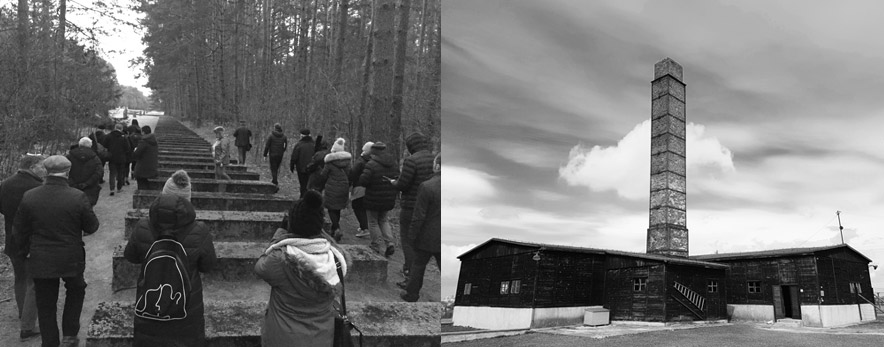
We arrived at Treblinka as the evening drew near. There is nothing left of the original Death Camp, it was destroyed by the Germans as they retreated in defeat. Our group processed in silence along the route taken by 900000 Jews on their way to the gas chamber. A huge stone monument stands at the site of the chamber doors. As we turned to look behind us in the gloom, we could see the land strewn with hundreds and hundreds of jagged stones, each a testament to an entire community that perished here. Some bear the name of the town it represents, some are too small for that. The stones reach the horizon and seem to go on beyond that. A myriad of Jewish histories, erased in the fifteen months of the camps existence.
Standing in the early grey of the morning at Majdanek Extermination Camp, I am struck by two things. Firstly, the camp sits on a busy highway, surrounded by a large residential area. It is openly placed; brazenly visible. Secondly, the cold is inescapable. A wind rips through the camp, clawing at any skin exposed to it. I am wrapped in thermal layers, with hat and scarf and gloves; and yet my eyes stream at the perishing cold. I am almost unable to concentrate on my surroundings in the biting wind. This is late March, on the cusp of spring. The temperature is many degrees higher than that of a Polish winter. I cannot imagine how a starved body in thin pyjamas would live, even for one day. The majority of those arriving at Majdanek were murdered immediately in the gas chamber, but those that were saved at the initial Selection, lived out the few weeks of their life expectancy in the direst conditions of cruelty.
On our second night in Poland, we walk to the Buczyna Forest, outside the city of Tarnow. It is known as the Children’s Forest. There we gather around an area fenced with a sky blue railing. We learn that within, are the remains of 800 small Jewish children. The children had been dragged from their screaming parents, brought to the forest, shot in batches and thrown into the pit. Infants, who were too small to be able to walk, were tied into sacks. When the pit was full of the corpses of the children, grenades were tossed in. It must have taken many hours to complete the killing. The screams of the children reverberating around the surrounding town.
The children were murdered here, because the German’s had found that taking them to the extermination camps slowed the process down.
Each of us there had a small piece of paper bearing the details of a child with a name similar to our own. We read aloud their name, their parents’ names and the place of their death. Each child murdered under the age of ten years old. I felt a silent howl rise up within my being that encompassed me entirely. I want to sing them a lullaby; I want to rock each child in my arms. Tears mix with the snow and run in rivers down my cheeks. Not because I am a woman, not because I am a mother, not because I am a Jew. Because I am still human.
By the time we reach Auschwitz I feel as though I can no longer feel. I have unconsciously anesthetised myself, in an attempt to stop the pain. We experience the devastating size of the place; this destruction-line death factory. We see the inhumane living conditions, the piles of children’s shoes and hairbrushes and suitcases. We pass by the block where the human experiments took place on twins, on dwarves, on pregnant women.
I look around though, at the people there on guided tours. Schoolchildren and pensioners on a day trip. What are you learning? What are you taking home from this?
Last night when I arrived home, I was compelled to get into a hot bath and scrub and scrub and scrub.
This morning, waking to a steel grey Manchester dawn, I know the question that will be repeated – What have you learned from this? How do we learn the lessons of history? How do we stop this happening again?
There is only one lesson to learn from the Killing Fields, and that is that man has an infinite capacity for evil, and once the evil is given free reign, it is impossible to turn it back. It takes the slightest touch of the blade to the vein, and the hate rushes out and soaks all in its path.
The lesson we really need to address, is how does the process begin? What are the first tentative steps that lead the way to this bitter end? The seeds of Antisemitism are small and almost hard to perceive, but when they are scattered onto fertile land, and nurtured and watered, they grow like weeds unchecked. Those tiny seeds are words like these:
Will the Jews ever stop moaning about the Holocaust?
They run the media you know
Well, you got your own land out of it didn’t you
Rothschild. Rothschild. Rothschild
The numbers don’t add up – it was never as many as six million
There must be a reason why everybody hates them
The Jews killed Christ
The Jews were behind the Twin Towers; the Wall Street Crash, the First World War, the Black Death, the rise of Communism, the rise of Fascism, American Foreign Policy, British Foreign Policy, slavery …………..
Israel is an apartheid state
Zio pigs
There is no Antisemitism now
And the lesson? Do we have the means to stop it? As Jews stand up now to Antisemitism, they are shouted down; told that they are exaggerating, embellishing and lying. We are forbidden from calling out the abuse against us. Perhaps our only hope is that those around us shout the truth with us. Our friends and neighbours; our work colleagues and our Civic Leaders need to stand beside us in the face of a process attempting to repeat itself – that will always attempt to repeat itself. We must engage with them and take them on the long road with us. By helping each other learn, we can lead the way together. Together we are stronger.
Maybe this is the lesson I have learned.
I will need to ask myself the question again tomorrow.
Rev Trudie Morris: REFLECTIONS ONE YEAR ON
Rev. Trudie Morris
I lived in ignorance of Jews or the terrible events of the Holocaust until well into my 30’s. As a child growing up in Bristol, I never encountered a Jew or learnt about the Jewish faith or the Second World War at school. The only Jew I sort of knew was Jesus and in my Sunday School pictures he had long blonde hair, no beard and of course, was almost 2,000 years old.
My parents both served in WW2. My Dad was in the army and stationed in Egypt for 5 years. My Mum was in the Women’s Royal Air Force and stationed in the West Country. The Holocaust never came up in those ‘what did you do in the war?’ conversations we had with our parents back then. After our visit to the camps last March I showed her our Journey to Poland guide book and shared a little bit of the visit. “Of course, we knew nothing of these events at the time” she commented. “There was nothing in the papers, on the radio.” I think for my Mum’s generation life post-war was all about putting that time behind them and focussing upon the future. So I grew up in ignorance. But I now know that ignorance is a dangerous commodity. Ignorance of other religious, cultural and social groups breeds fear, distrust, contempt. My lack of knowledge was not confined to the Jewish people and faith. Within my own Christian faith as a child I did not meet any Roman Catholics so these were also regarded with suspicion.
When I began my first teaching post as an English teacher, a Year 9 set text was ‘Friedrich’ by Hans Peter Richter. This novel, first written in German, was my first introduction to the experiences of Jews in Hitler’s Germany and I learnt this alongside my students.
Friedrich Schneider is a young Jewish boy growing up in an apartment house in Germany, with the narrator as his neighbour and friend. The narrator tells of the persecution of the Jews through Friedrich’s eyes. Friedrich is forced to switch to a Jewish school and is thrown out of swimming pools and cinemas. An angry mob goes to his house and kills his mother. His father is sacked and has an emotional breakdown. Friedrich finds a girlfriend, Helga, whom he likes, but soon he must stop seeing her, or she will be sent to a concentration camp.
Friedrich and his father are forced to do whatever they can to make money to survive. Friedrich helps his father hide a rabbi in their house, but soon Friedrich’s father and the rabbi are arrested. Friedrich, who was not home when the police came, now must live in hiding. Herr Resch, their former Landlord and his wfe, return to their house after an air raid and notice Friedrich on the step, apparently unconscious. Herr Resch decides to get rid of him by kicking him, and they realize that Friedrich is dead, killed by shrapnel. Resch then remarks that Friedrich has died a better death than was expected.
This was not an easy read for my 13-14 year olds or me. It was a novel, I had no idea how believable the story was. However, alongside, we also read ‘Ann Frank’s Diary’ and this true account of a young Jewish girl in hiding who died in a concentration camp, began to give me a glimpse of the horrors of the Holocaust. Enough of a glimpse for me to imagine the unimaginable. There, to my shame, I wanted to leave my limited experience. Years later, last year and just arrived as Rector of All saints Stand in Whitefield, Mayor Jane Black, invited me to take part in a civic trip: Journey to Poland, a three-day-tour through the camps. Every nerve in my body jangled “no”. I had had opportunities to visit before, as a teacher and when training for ministry. But this time I said yes. That was in March. Saying yes, did not make it any easier. On the trip were Jews and non Jews from all over Bury and beyond. Some knew each other but each person’s experience was unique to them. Some shared these, wrote about them and took pictures. I couldn’t do any of these things.
My way of coping with the horrors of the Treblinka, Majdanek and Auschwitz II-Birkenau extermination camps, was to retreat into myself. The 800 Jewish children from an orphanage in Tarnow, who were marched to a clearing in the nearby Buczyna forest and and silenced, I could not possibly speak of. It was enough to read aloud in that dar, cold, sleety forest, the name and scant details of a child given to me: “Truda Fink, daughter of Kuba and Resia, died aged 10.” I later found Truda’s name in the room-sized memorial book of the dead in the Auschwitz museum.
What do we do about unspeakable horror? This has been my lesson. Unless we find voices to speak, do speak out, challenge bigotry and racial hatred history will simply go on repeating itself. I commend the Poland Legacy Group in its work to ensure that children like I was, do not grow up ignorant or fearful of others who happen to be born into different family groups to theirs but excited by and willing to embrace, the beautiful God-given diversity of our common humanity on this planet.
Brad Marshall: FROM WARSAW TO AUSCHWITZ
BRAD MARSHALL, of the Bury Times, reports:
AFTER a civic welcome in Warsaw’s central district and discussions about strengthening ties between the between Bury, Trafford and Warsaw we began our journey proper, into remembering the Holocaust and the horrors inflicted upon millions at the city’s Jewish cemetery.
Built in 1806, the grave yard was left intact by the invading Nazis who intended to preserve the site as a museum to the destruction of the Jewish people.
Had they won the war and succeeded in their genocides the Nazis meant the cemetery to stand as a lasting reminder that they had eradicated what they deemed an inferior race.
Today the cemetery is home to 320,000 graves, 250,000 marked by beautifully designed headstones bearing Hebrew, Yiddish and Polish inscriptions.
Yet 70,000 victims of the Warsaw Ghetto lie in two mass graves. And it was in the area of the ghetto where we continued our journey.
Before the outbreak of the Second World War Poland was home to around three million Jews, of which around 350,000 lived in Warsaw and made up 30 per cent of the city’s population.
Warsaw’s was the largest Jewish community in Europe, but under German military occupation the city’s Jews and those from surrounding areas were ordered to live in a ghetto.
Sealed off from the rest of the city by a 10 foot wall ringed with barbed wire, more than 400,000 people were crammed into an area of just 1.3 square miles.
Devastating starvation and disease were rife and people were mercilessly exposed to the elements, killing tens of thousands.
In 1942 deportations started to the extermination centres created across Poland by the Nazis, and in April 1943 a large force of SS and police arrived to ultimately liquidate the ghetto’s inhabitants.
However unwilling to give in to their destruction the inhabitants launched an uprising.
Although poorly armed, the insurgents were initially successful and were able to resist the SS and police units for several weeks.
As we walked through the area the ghetto had occupied we traced the movements of the uprising, following the “Heroism Route”, until we reached the last bunker to hold out resistance, known as Mila 18.
At least 7,000 Jews died in the uprising and another 7,000 were sent to the Treblinka extermination camp.
In the heart of the former ghetto a monument stands to the uprising’s heroes. Depicting the fighters themselves as well as Jews being deported, the sculpture is a powerful and moving tribute to the bravery shown by thousands of persecuted Jews, and a reminder that heroism in times of absolute darkness takes many forms.
Leaving Warsaw we made our way through the lush Polish countryside and forests to Treblinka.
The camp was one of three constructed in central Poland under Operation Reinhard, a top secret order to undertake the “final solution” and exterminate the Jews in German-occupied territory.
Consisting of little more than a rail platform, barracks complex and gas chambers Treblinka was a factory of death, capable of allowing 2,000 people to be murdered in a single hour. Between 1942 and its closure in 1944 almost 900,000 people were killed.
Polish authorities built a huge memorial in the 1960s with hundreds of stones bearing the names of towns and countries where the victims came in the outline of the camp.
Resembling a harrowing graveyard these stones encircle a monolithic stone arch and black stone sculpture marking the location of the gas chamber and burial pits respectively.
In the still twilight we returned to our coach to drive to Lublin and considered the sobering thought that we walked a return journey many thousands did not.
Calling at an historic Yeshiva, formerly the largest and one of the most prestigious rabbinical schools in the world, we travelled to Majdanek, a sprawling concentration and extermination camp built on the orders of the head of the SS, Heinrich Himmler.
It was intended to provide slave labour for the German Reich, and was notorious for its brutal living conditions.
Thousands were killed in mass executions, hangings, by phenol injections and being drowned in sewage pits.
Between late 1942 and September 1943 prisoners, mostly Jews, were also sent to gas chambers.
Final liquidation of the camp took place in July 1944 as the Soviet Red Army advanced, when hundreds of prisoners were transferred to other camps, including Auschwitz.
Travelling south we stopped in the village of Markowa, home of the Polish Ulma family of Jozef, Wiktoria and their six children,who sheltered eight Jews during the war.
However in March 1944 they were discovered by the military police who shot all the Poles and Jews — including the children and Wiktoria who was in labour with the Ulma’s seventh child.
In 1995 the Ulma’s were posthumously honoured with the Righteous Among the Nations title and a monument now stands in the village to their heroism and selflessness.
Markowa was subsequently chosen to be the home to a Museum of Poles Saving Jews, recognising the role played by Poles, including around 1,000 who were killed by the German for attempting to help Jews.
Continuing we visited Tarnów and the town’s old Jewish Quarter, where defunct painted signs still remain — including for a Jewish food store — and there stands the little remaining structure of the destroyed synagogue, now a monument.
The town is a beautiful coalescence of Central European architecture lining charming cobbled streets, but it too is scared the horrors of the Holocaust.
There, as in many other places in Poland, a ghetto was established shortly after the German invasion, and in the town square Jewish inhabitants were rounded up the Nazi secret police, the Gestapo, and children were executed.
Some 40,000 Jews were imprisoned in the ghetto before the Nazis began carrying out mass executions in the nearby Buczyna forest in June 1942.
As night fell we continued to the forest outside Zbylitowska Góra and perhaps the most solemn and heart-rending moment of our trip.
Known as the Children’s Forest, the area is filled with mass graves, including from the most notorious murder of 6,000 Jews, including 800 children, who were thrown into the pits and killed with hand grenades.
In the black of night, with snow and rain falling we made our way to the graves.
There we held a memorial with each member of our group reading out the name of a child victim of the Holocaust, researched by our guide and sharing a name identical or similar to our own.
In the silent solemnity our guide, Jeremy Kurnedz, the son of a Holocaust survivor, encapsulated our sorrowful remembrance, saying: “Perhaps the heavens are weeping. The weather is appropriate.”
From the forest we made the final leg of our journey to Krakow and to the infamous Auschwitz — the largest Nazi death camp where more were killed than at any other.
Krakow has been home to Jews since the 11th century, and by the 14th century a distinct Jewish district, the Kazimierz, was thriving.
At the outbreak of the Second World War tens of thousands of Jews lived in Krakow, making up a quarter of the city’s population.
This population was decimated by the Holocaust and the Krakow Ghetto.
However unlike in many areas of Poland the city’s Jewish community population and culture has slowly rebuilt itself and is once again flourishing.
In the city we visited several synagogues filled with people and the sound of Hebrew prayers — including one the of the oldest, the 16th century Remuh Synagogue, and one of the youngest, the Tempel opened in 1862.
Leaving the city behind we journeyed a few short miles east to Oświęcim and made our final stop.
It is said all roads lead to Rome, but in the Nazi Reich all railroads led to Auschwitz. Jews and other persecuted minorities were brought from all over Europe, often travelling for days or weeks, crammed into cattle carts.
The camp was divided into three sections: I an old army barracks initially used to house political prisoners but later expanded, II (Birkenau) the purpose built extermination camp and home to the main gas chambers, and III a series of factories where prisoners were worked to death for some of the world’s largest companies.
In total 1.1 million men, women and children were killed at Auschwitz and to walk the site of incomprehensible evil is an unforgettably horrifying experience.
As we concluded our trip we were left haunted by the sheer brutality, loss and inhumanity inflicted by the Nazi regime, but also the incredible heroism and unbreakable spirit of the Jewish community. We were reminded that we must never forget and commit to the vow of never again.
Harry Johnston: THE DIFFICULTY ON RETURNING
Harry Johnston: The Difficulty on Returning
You ask of my experience with the Poland trip and I’ll try and keep it brief.
Before I went I had certain expectations and did not even consider any potential emotional damage that may result.
As we went from one site to another I realised I was in a nightmare, but kept telling myself that “tomorrow won’t be as bad as today”. However the tomorrows were worse.
I found myself getting more and more introverted and couldn’t sleep or express my feelings even to those who were very close to me and on the trip. However they understood that I wasn’t right.
I took to taking things out of context and over reacting. I questioned photograph taking as my mind told me that what I was seeing would be imprinted on my mind until the day I moved from this world to the next.
I remember our guide getting irate with someone who became a nuisance outside a church when we were gathered around and shouting for our security guy to come ” get rid of him” I thought my G-d in different times what would that have meant. But then that didn’t leave me it just went round and round in my head.
When I got back, I couldn’t sleep, I lost weight and started to dread the ping on my phone indicating more photos, and everything was out of context. I couldn’t discuss it without becoming emotional about it. I needed help. I have a very long-standing Rabbi chum of some 50 years who I turned to. I know him well and he knows me well. He set up a regular meeting and all I did was talk, no questions. Just talk on how I felt. He eventually stated that my mind was damaging me as it was asking for answers that no one could give, he advised me to do what most people who go through these things do and that was close it down. How do people carry on, like my late father who spent 156 days in an open life boat… 22 set out and just 2 left alive when picked up, manage any kind of normality when they come back, they shut it out. We hear it over and over ” he/she never talked about it”. We watch the old boys on TV at Remembrance Services when they have to share and face up to it, they regularly break down with the thoughts they have to bring out from the dark reaches of their memories.
So that’s what I did, I shut it down – it was that or lose my mind with it.
I could fill a few pages with this but I think you may understand.
I hope this helps people to understand that we can’t all be strong when faced with such questionable features of the human race. We deal with it as best we can. I know from others that they too struggled with it on return. One person told me they took a bath and tried to scrub themselves clean of it whilst shedding buckets of tears. Until speaking to me they hadn’t told another person.
Rachel Coaker: …WE THEN CHANGE OUR LIVES
Rachel Coaker:
There are no life changing experiences,
only experiences so powerful that
we then change our lives.
In this blog posting, Rachel Coaker, Deputy Chief Finance Officer at the CCG, shares some reflections after taking part in a civic trip from Bury to Poland to understand more about the Holocaust and war.
Several years ago, I found out that as a result of an affair, my maternal grandfather was Polish, who for some reason was in Liverpool in 1943. Not much else is known as the family tried to wipe the indiscretion from memory. Were they Jewish or Roma fleeing persecution or were they part of the navy and air forces that supported the war effort? Since finding out, I have always been interested in visiting Poland and understanding more about the Holocaust and war. The opportunity to take part in this civic trip was very welcome.
I really didn’t know what to expect from the trip. I knew that we would be covering a lot of ground, both geographically and things to visit. Nothing could really have prepared me for the reality.
Our tour guide Jeremy was the son of a Holocaust survivor, who not only had dedicated his life to sharing information so the atrocity wouldn’t be forgotten, had the ability to draw you with his passion and incredible stories that brought every element of the trip to vivid life. Not only the pain and sorrow of what happened, but the joy of the relationship that he had with his father, family and wider community.
Our first day started in Warsaw, which was initially, particularly after a 2am start to get to the airport, a bit surreal. We stood in the Warsaw Jewish cemetery next to two mass graves of about 70,000 people and we saw the sewers where tiny children would create supply lines to try to get food to the people starving in the ghettos, amongst other things.
The first day ended with a visit to Treblinka, a Nazi extermination camp. We arrived around dusk as other tourists were returning to the car park, so it was just our group. In this pristine forest, listening to the birds roosting, we walked up to where the train tracks ended and people would get off the packed trains and go to the only destination for them in that place, the gas chamber.
As the Nazis destroyed Treblinka to try to eliminate any evidence of this horrific place, what remains is a memorial, surrounded by jagged rocks that represent all the communities that have been affected by what happened here. After walking around and trying to take it in we stopped at the rock that said ‘Piotrkow’. This is where Jeremy’s dad’s family had been from. All of his immediate family were murdered here. His father the only survivor.
I want to sing them a lullaby; I want to rock each child in my arms. Tears mix with the snow and run in rivers down my cheeks. Not because I am a woman, not because I am a mother, not because I am a Jew. Because I am still human.
On day two we continued to Majdanek, a brutal place. We saw the camp, the gas chamber, the ovens and the huge memorial with an incomprehensible pile of human ashes that were recovered from the surrounding areas. All of this is still difficult to absorb, but the most shocking thing for me is that this place isn’t hidden in a forest, miles from anywhere. This place was next to a town, in full view. The suffering, the shots, the smoke, the use of human ash to fertilise local farmland was all there, day to day, in full view.
After dinner we went to the Zbilatowska Gora forest in Tarnow. It was dark and sleeting and we walked to the site of several mass graves. We stopped at one. This was the place where 800
children and babies had been murdered and buried. We stood next to the grave and we each had been given a name to read out. One of the one and a half million children who were victims of the Holocaust.
Mine was:
Rachel Abrevaya; daughter of Joseph; born in Kavala, Greece; murdered in Treblinka at the age of eight.
Throughout the trip, as a non-Jewish person, the insight in to Jewish life from the places we went, like the synagogues, the Jewish quarters and from experiencing it with the Jewish people on the trip was a privileged insight that I don’t think I would ever had got otherwise. The sense and depth of feeling for family, friends and community and the feeling of shared experience was overwhelming.
The final day finished at Auschwitz II (Birkenau) and Auschwitz I. Seeing in person some of the iconic images together with getting an insight into what life must have been like was difficult. Although destroyed, seeing the size, extent and efficient order to the killing factories was chilling. The centre of a Europe wide rail network with a single destination, hard labour or a gas chamber. Jeremy had asked us to take a small stone from Auschwitz to put somewhere at home so when we see it, we can think about what we had seen and experienced. He finished the trip reflecting on his view that there are no life changing experiences, only experiences that are so powerful that we then change our lives.
The trip was so amazing, quick, powerful and exhausting that it is difficult to take everything in. It was only when I was on the plane back, sat in front of a baby crying, but the kind of crying where they are really in distress, that part of what I saw and heard started to sink in.
The mum was trying to sooth the little baby and their siblings trying to distract and comfort them. At that point I could imagine what it would be like for that baby and children to be wrenched from their mother or like in one of the stories that we heard, for that mother to be told to choose which of those children she would save and which she would let go.
Throughout the trip I thought about the human condition, wondering how this happened and thought about other current situations like the refugee camps in Syria where thousands of people are displaced, murdered, raped and starving, with the rest of the world watching. Thinking about how in our communities many of the conditions that preceded the war, inequality and poverty, are returning with the associated rise in intolerance.
I wondered whether the reaction of ‘What on earth am I doing with my life?’ is usual and have continued to reflect on what else I can draw from the trip. From a work perspective, I thought about how important good leadership is in setting culture and how a damaging culture focused on positioning and politicking is, with the use of physiological means to diminish people’s ability to contribute and flourish through exclusion and control, and that it must be avoided.
It also brought to the forefront of my mind the resilience of the survivors who even after this atrocity were able to rebuild their lives. It is easy to get caught up in the day to day, but focusing on individuals, recognising uniqueness and individual contribution really needs to be at the forefront, supporting true inclusion and diversity of not only race, religion, ability but also perspective and approach.
Since I have been back the events and thoughts still go through my mind. One of the trip participants shared a blog by Elie Wiesel, Holocaust survivor and Nobel Peace prize winner. In the blog Elie says that passiveness and indifference is worse than evil. There is no situation where I don’t think that applies.
I looked for my little girl’s name, Rachel Abrevaya, on the database of names of victims when I got home. Of the five Abrevayas from Kavala, there were two others who were children of Joseph. Regina, 27 and Esterina who was only three. All murdered at Treblinka. I thought about how only days before I had walked to where they would have disembarked the train and how I walked along where they would have walked together, probably carrying Esterina, terrified, to that inexplicably horrific place and last place that they would ever see.